


Jordan Lam
Carney’s latest trade deal with China: Necessary or risky?
Carney’s latest trade deal with China: Necessary or risky?
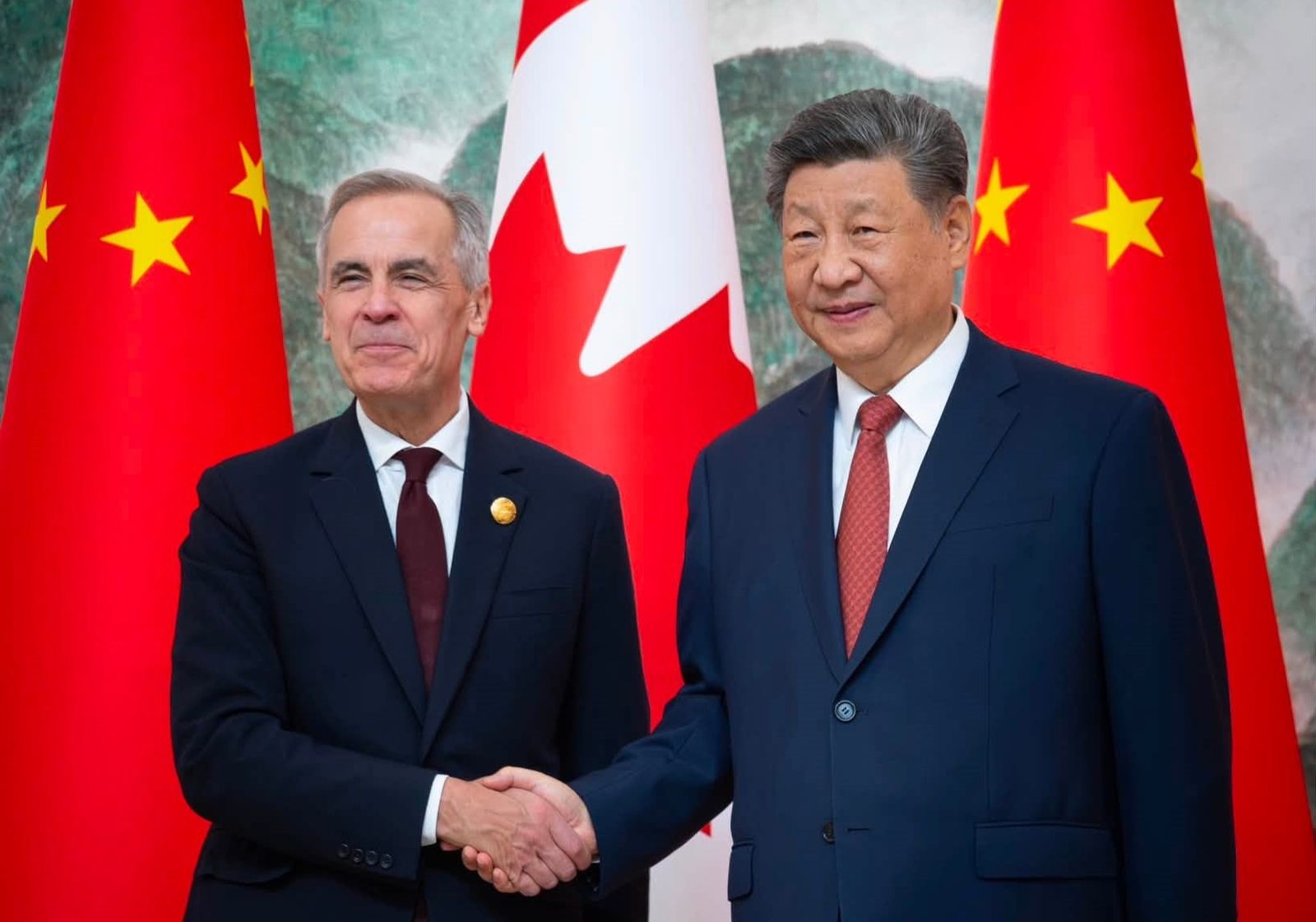
Photo: Mark Carney, Facebook
The Topline
- On Nov. 17, Prime Minister Mark Carney met Chinese President Xi Jinping on the sidelines of the APEC summit in Shenzhen, where the two countries agreed to reduce tariffs on about $400 million of Canadian pork and seafood and on certain Chinese steel and aluminum products
- The Conservatives released a statement criticizing the move, suggesting the new trade deal puts “national security at risk.”
- In an effort to diversify trade away from the U.S., Carney became the first Canadian prime minister to visit China since 2017, in an effort to increase exports to China by 50 per cent by 2030
- Canada’s relationship with China broke down in late 2018, when Canada arrested Huawei executive Meng Wanzhou at the request of the U.S. and China subsequently detained Canadians Michael Kovrig and Michael Spavor for nearly three years in what Ottawa called an arbitrary detention
Never miss another side to every story
Sign up for The Level's 5-minute newsletter, 3x per week
Thanks for subscribing!
Check your inbox for an email to confirm you're on the list. If there's no email, check your spam filter just in case, then mark us as 'not spam' so that you never miss an issue.
Switch sides,
back and forth
You can walk and chew gum at the same time
Whether we want to admit it or not, Canada can’t afford to do business with only countries that share the same values.
When Mark Carney spoke about his trade strategy at the World Economic Forum back in January, he called it “value-based realism.”
Borrowed from Finnish President Alexander Stubb, it essentially means “we aim to be both principled and pragmatic” and “not every partner will share all of our values.”
We’ve seen it in action as Canada has struck deals with countries like Qatar and the United Arab Emirates . But no country has drawn more attention than Carney’s softening relationship with China.
Ontario Premier Doug Ford called January’s electric vehicle deal “terrible” and U.S. Treasury Secretary Scott Bessent suggested Carney had done “some kind of about-face.”
Those concerns aren’t baseless; China is not a democracy, its labour costs are hard to match, and it has long been accused of stealing intellectual property from foreign companies.
But let’s face it — China is an economic giant that can’t reasonably be ignored. It’s Canada’s second-largest trading partner, and as Jia Wang of the University of Alberta’s China Institute pointed out this week, Canada does more than twice as much trade with China alone as it does with all of Southeast Asia combined.
That’s a big deal because when it comes to global trade, 72 per cent of Canada’s goods exports still went to the U.S. in 2025 — a country now slapping tariffs on certain Canadian products.
Wang suggests Canada has to “walk and chew gum at the same time.” In other words, we can take the risks seriously while still doing business with Beijing.
The strategy is already moving the needle. The January deal cut Chinese tariffs on canola seed from about 85 per cent to roughly 15 per cent, and exports to China rose 31 per cent in the first half of this year.
It’s not as if Carney is looking for the same relationship with China that he’s pursuing with the European Union. The latest agreements with Beijing have mostly covered farm products and seafood, the EV quota is capped at under 3 per cent of Canada’s new-vehicle market, and Carney insists Ottawa is keeping guardrails in place.
Carney knows the deal: A market as large as China can’t be ignored.
And if that’s the case, let’s not pretend we’re only interested in doing business with like-minded countries.
It’s (still) Canada’s biggest security threat
When asked during the 2025 federal leaders’ debate to name the biggest security threat facing the country, Carney said: “I think the biggest security threat to Canada is China .”
There’s good reason for that.
A federal public inquiry into Chinese meddling in the 2019 and 2021 federal elections called China “the most persistent and sophisticated foreign interference threat to Canada.”
In 2022, a Hydro-Québec researcher was charged with stealing trade secrets for China, while in 2023, Global Affairs Canada accused China of spreading misinformation about Conservative MP Michael Chong. And a recent report published by international human rights group Safeguard Defenders claims that at least 18 Chinese police monitoring stations exist in Canada.
Then there’s the incident that arguably set the dumpster on fire. In December 2018, at the request of U.S. authorities, Canada arrested Meng Wanzhou, a senior executive at Chinese tech giant Huawei, as she changed planes in Vancouver.
China’s response was swift. Nine days later, it detained two Canadians, Michael Kovrig and Michael Spavor, and held them for nearly three years in what Ottawa called an arbitrary detention . It also blocked some Canadian canola exporters .
The two Michaels headed home in 2021 — the same day Meng’s case was resolved — highlighting exactly what doing business with Beijing can mean.
When China has a bone to pick, it doesn’t hesitate to take hostages and punish innocent bystanders, whether it’s Candians living and working in the country or canola farmers trying to make a living.
That’s why every trade agreement that makes Canadian industries more dependent on Chinese buyers also gives Beijing more leverage — literally the same thing that became our weakness once the U.S. decided to pull the plug on free trade between us.
That’s also what makes these trade deals worrying. On one hand, Ottawa is warning Canadians that China is using job postings to lure ordinary people into sharing sensitive information, while on the other hand, Canadian and Chinese military officials quietly resumed strategic talks in September.
It’s a fair point to suggest Canada can’t afford to stop trading with China completely — nor should it.
But the same country that Carney called our biggest security threat hasn’t changed much in the past year; only our need for more global customers has.
That should give Ottawa serious pause before going any further.
Do you support journalism that helps Canadians navigate difficult issues with more context and less outrage?
Every dollar goes toward helping Canadians see another side to every story so they can form their own opinion.
