


Jordan Lam
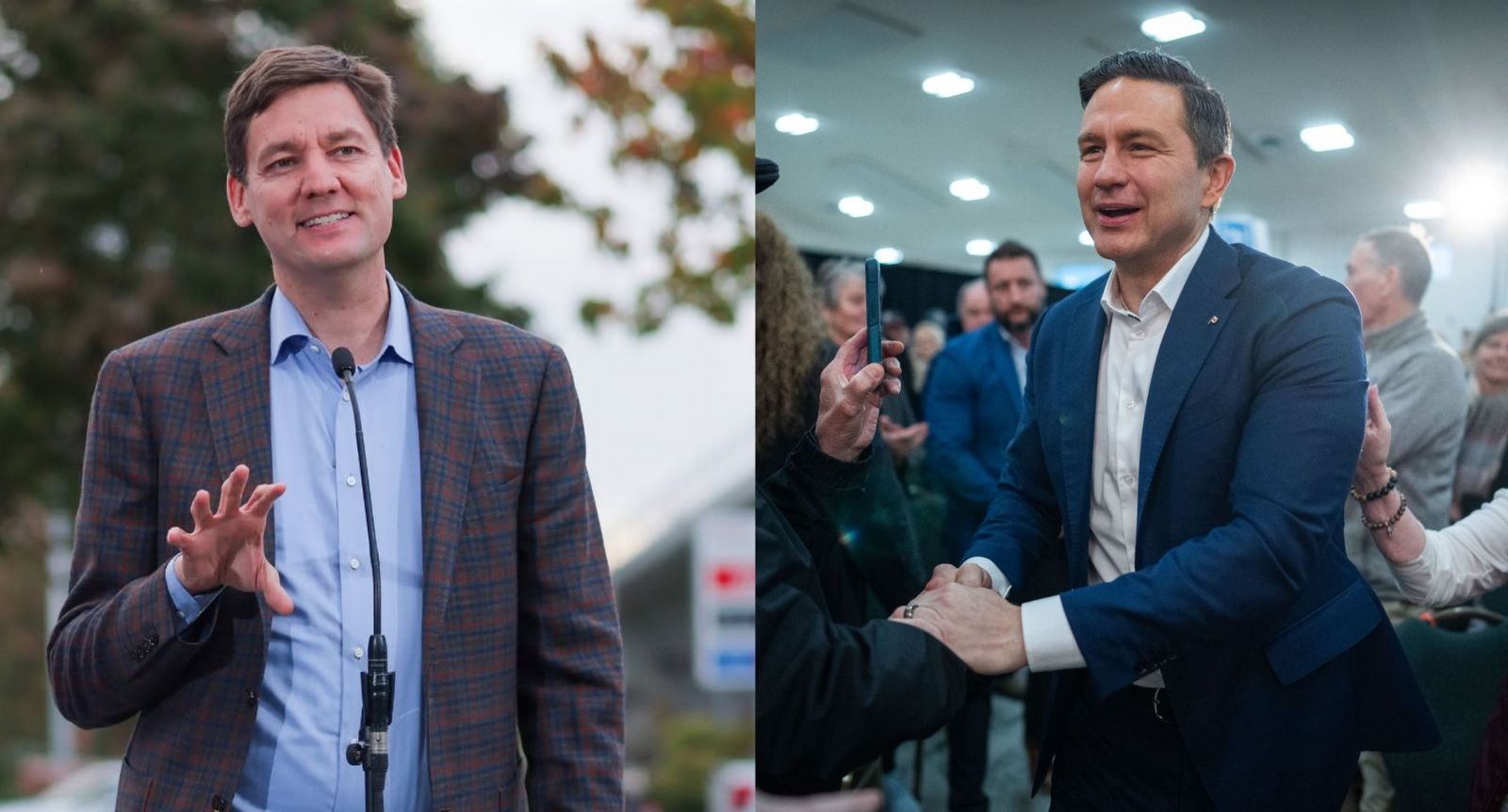
Poilievre or Eby: Who had the bigger fail?
Poilievre or Eby: Who had the bigger fail?
The Topline
- In December 2024, the Angus Reid vote intention tracker showed Pierre Poilievre’s Conservatives at 45 per cent compared to 16 per cent for Prime Minister Justin Trudeau’s Liberals.
- After Trudeau announced his resignation in early January 2025 and was replaced by Mark Carney in March, support for the Liberals had jumped to 46 per cent, Carney won the April 2025 federal election, and Poilievre lost his own seat.
- On Sept. 22, 2026, B.C. Premier David Eby called a snap election two years early, hoping to win more seats and a fresh four-year term due to instability within the opposition Conservative Party.
- Just over a month later, the election was held, the Conservatives won the biggest majority in B.C. since 2001, and Eby announced he would resign as NDP leader.
Never miss another side to every story
Sign up for The Level's 5-minute newsletter, 3x per week
Thanks for subscribing!
Check your inbox for an email to confirm you're on the list. If there's no email, check your spam filter just in case, then mark us as 'not spam' so that you never miss an issue.
Switch sides,
back and forth
Poilievre let it slip through his hands
Even a year and a half later, Pierre Poilievre must still lie awake some nights wondering how it all fell apart so fast.
In late December 2024, polling showed support for Justin Trudeau’s Liberals had fallen to historic lows and his own government was turning on him.
Trudeau resigned — citing “internal battles” — and Mark Carney, a former central banker who had never held elected office, won the Liberal leadership.
The decision to replace Trudeau with Carney was outside of Poilievre’s control. But he still deserves much of the blame for failing to pivot his strategy accordingly.
Every campaign is built around an opponent, and for the past three years Poilievre’s was Justin Trudeau. He relentlessly and ruthlessly attacked Trudeau at every chance. Maybe it worked too well.
Having already spent millions on ads targeting Trudeau, Poilievre had no plan for Carney. He resorted to using nicknames like “ Carbon Tax Carney ” — even after Carney scrapped the consumer carbon tax.
To voters, it felt like the party was trying to run a campaign against the ghost of an old leader instead of addressing anything about the new one.
It didn’t help that Poilievre also isolated himself from the media. News coverage is how most voters get to know a leader, but reporters were kept off his campaign plane and bus, questions were capped at four per event, and Conservative candidates were encouraged to skip local debates.
Meanwhile, Carney, a man most Canadians barely knew, was fielding roughly three times as many questions early in the campaign, with every answer being another chance for Canadians to get to know him and judge his ability to do the job.
Both candidates had to convince Canadians they could handle Canada’s relationship with U.S. President Donald Trump. Carney was the calm, stoic central banker. Poilievre stuck to his combative rhetoric, leaving voters questioning if that would fly with Trump.
He also spent the prior fall attacking Jagmeet Singh and the NDP. That backfired when a weakened NDP eventually collapsed, robbing the Conservatives of any vote-splitting between the NDP and the Liberals.
Conservatives like to point out that the party gained two dozen seats and won more votes than in any election since 1988. But that’s cold comfort when they were practically guaranteed a majority win.
Instead, Poilievre came away with his party’s fourth straight loss and — to top it all off — lost his own seat.
If you measure a political mistake by how much it cost, it’s hard to beat that one.
A disaster entirely of Eby’s own making
Nobody forced David Eby to call an election only two years into his four-year term. But his gamble ended up costing the NDP its majority government.
B.C.’s next election wasn’t supposed to happen until October 2028, and politicians are supposed to know that calling an early election always comes with the risk of angering voters.
In the 2024 election, the NDP had survived a nail-biter, winning a majority government over John Rustad and the Conservatives by just a single seat. Since then, the economy had stagnated, B.C.’s debt had soared, and Eby’s popularity had tanked.
The one thing going for Eby was the Conservatives’ utter instability. Rustad was forced out, Kerry-Lynne Findlay was elected to replace him, several MLAs were either fired or had fled, and Eby was convinced it was perfect timing for an election against Findlay.
Here’s the plot twist: Findlay decided to step down. But instead of recognizing his ideal opponent was no longer there, Eby still called the election.
Voters seemingly found that too cynical to stomach. Meanwhile, the Conservatives rallied around their new interim leader, Lorne Doerkson, whom David Eby even called a “nice guy.”
Without Findlay, the election suddenly became a referendum on Eby who, by the way, never gave voters a convincing answer as to why there needed to be an election to begin with.
First he said it was because of U.S. President Donald Trump. When voters didn’t buy it, he talked about his fragile majority of just one seat — eventually regretting that he hadn’t explained himself better.
If by the final week of an election campaign, the biggest question a leader is still facing is why an election needed to happen at all, that’s a bad sign of things to come.
Eby also ignored the municipal leaders from around the province who condemned him for calling a provincial election right in the middle of B.C.’s municipal elections.
Even worse, the NDP itself seemed wholly unprepared, failing to nominate a candidate in one riding, while sending Eby out on a campaign bus that carried no branding at all.
When the votes were tallied, the result was a worst-case scenario for Eby. The NDP dropped from having won 47 seats just two years ago to winning just 28 seats, with the final count still yet to be announced. On election night, Eby announced his plan to resign.
Eby could have been premier for two more years. But instead he pushed his chips all in, lost the NDP’s majority, and ultimately had to announce his resignation as party leader.
Do you support journalism that helps Canadians navigate difficult issues with more context and less outrage?
Every dollar goes toward helping Canadians see another side to every story so they can form their own opinion.
