


Neil Malik

Stephen Smysnuik
What’s the Venezuela situation really all about?
What’s the Venezuela situation really all about?
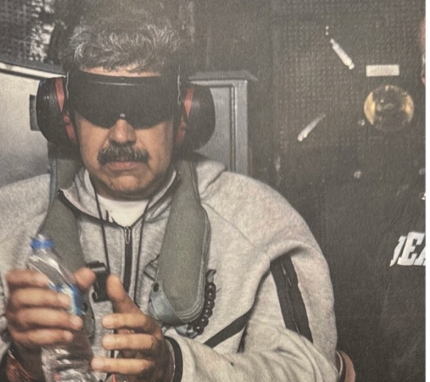
Photo courtesy of @realDonaldTrump / Truth Social
The Topline
- The U.S. launched a rapid military and intelligence operation in Venezuela on Saturday that resulted in the removal and capture of President Nicolás Maduro
- President Donald Trump said the U.S. would temporarily “run” the country, with Venezuelan oil revenues used to fund stabilization and infrastructure repairs
- The U.N. argued the operation sidelines international law, and amounts to illegal regime change and resource seizure
- Supporters say Maduro’s removal ends years of repression and economic collapse, with some Venezuelans cautiously welcoming the change
Never miss another side to every story
Sign up for The Level's 5-minute newsletter, 3x per week
Thanks for subscribing!
Check your inbox for an email to confirm you're on the list. If there's no email, check your spam filter just in case, then mark us as 'not spam' so that you never miss an issue.
Switch sides,
back and forth
Maduro had it coming
Venezuelans across the world are celebrating the news of Maduro’s capture.
Yes, it’s fair to question the U.S. (or any country for that matter) for invading another territory and capturing its leader, even if said leader happens to be an oppressive dictator. But when you look at the history of Venezuela under Maduro’s control, it’s easy to see why many are cautiously optimistic.
In 2013, after Hugo Chavez’s death, Maduro won the vote for presidency by a narrow margin, ignoring the fact many Venezuelans questioned and protested the result.
Over the next decade, under his control, over 20 million Venezuelans found themselves living in poverty without access to food and essential medicines. Roughly eight million Venezuelans fled the country over that same period.
When a presidential election was finally held again in 2024, Maduro barred the opposition leader (and recent Nobel Peace Prize winner) María Corina Machado from running against him. She then named Edmundo González to run in her place.
Here’s where it gets wild. Following the vote, scanned copies of voting tallies, acquired by opposition activists, were uploaded to a website and showed González won 67 per cent of the vote, compared with 30 per cent for Maduro.
Maduro naturally called the tallies a fraud, but it didn't matter. The U.S. and other countries subsequently recognised González as the country’s leader instead. And yet, Maduro still didn’t budge.
That’s an important point in all of this. Typically, sovereign heads of foreign states are immune from prosecution under international and U.S. law. But, in Maduro’s case, the U.S. doesn’t see him as the country’s legitimate leader. So they’ll certainly argue that immunity wouldn’t apply to him after charging him with cocaine trafficking and narco-terrorism
Meanwhile, Venezuela’s living standards plummeted by a staggering 74 per cent between 2013 and 2023. Its oil output collapsed from historical highs to a fraction of past production, largely because of mismanagement, lack of investment, and the subsequent international sanctions starting in 2019.
But oil aside, and perhaps most importantly, Maduro was subjecting his people to an authoritarian regime that largely ignored human rights.
A U.N. fact-finding mission reported that in the first week of post-election protests, more than 2,000 people were detained, with many subjected to torture.
Human Rights Watch has also documented thousands of detentions, killings, enforced disappearances, and torture or ill-treatment of detainees by Venezuelan authorities.
Now, the U.N. has also argued the U.S.’s operation to remove Maduro violates international law and potentially harms Venezuelan sovereignty. But judging by the reaction of many Venezuelans across the world, they’ll still call it a job well done.
Trump has “empire” on his mind
Last November, President Donald Trump signed an updated National Security Strategy that describes plans for assertive U.S. dominance over the Western Hemisphere.
Included in that document is the “Trump Corollary,” an addendum to the Monroe Doctrine of the 1820s that declared the Americas off-limits to further European colonization. Trump’s addendum states the U.S. will ensure that governments in the Western Hemisphere “cooperate with us” through “continued access to key strategic locations.”
Venezuela appears to be the first of these strategic locations, and the operation last Saturday to remove Maduro from power was the warning shot of Trump’s ambitions for a new global order, with American dominance of the Western Hemisphere.
The Trump administration argued that Maduro was a problematic dictator who had to be removed, alleging that he's “a narco-terrorist in league with drug cartels.” But if Trump cares so much about drug cartels, why did he pardon former Honduran president Juan Orlando Hernández, who was convicted in 2024 of conspiring with drug traffickers?
The freedom and safety of Venezuelans matters little, if at all, to Trump. As the Globe and Mail’s editorial board argues , “Trump has no interest in restoring Venezuelan democracy, or in helping the people who have suffered the rule of Mr. Maduro and his predecessors from Hugo Chávez onward for much of the last three decades.”
Instead, this is viewed by many – including those on the Globe’s editorial board – as the attempted plunder of one nation’s oil reserves to shore up a new American empire.
Venezuela holds the world’s largest proven oil reserves, and by gaining control of them, it gives the U.S. a strategic advantage in the region by attempting to push rivals like China and Russia out of the equation .
It could also weaken the Canadian economy, which is heavily reliant on the U.S. buying Alberta oil — an industry now facing a new geopolitical shock. Indeed, Canadian oil stocks are down following Maduro’s capture.
Trump, meanwhile, has already turned his attention to other countries, saying that “something’s going to have to be done with Mexico,” doubling down on threats to annex Greenland , and making generalized threats to Colombia and Cuba .
The president said on Saturday that the U.S. will “ run ” Venezuela for the time being, with Venezuela’s oil revenues paying the costs. On Sunday, Trump told reporters that he spoke with oil companies “before and after” the attack and described them as being crucial to “fix the infrastructure.”
It’s way too early to say how this will all play out. Venezuelans themselves are cautiously optimistic about what a regime change could bring – though any change is merely a by-product of the Trump administration’s imperial ambitions.
